7/25/10

Predicting DeVry's share price

According to [1], the model for DeVry (DV) is defined by the index for the rent of primary residency (RPR-CUUS0000SEHA) and that of pets, pet products and services (PETS-CUUR0000SERB). The former CPI component leads the share price by 11 months and the latter one leads by 4 months. Figure 1 depicts the overall evolution of both involved indices. From our past experience, the larger is the lag the more unreliable is the model. However, both defining components provide the best fit model between August 2009 and June 2010. The positive influence of RPR (+7.90) is compensated by the negative input of all other terms . So, the best-fit 2-C model for DV(t) is as follows:


DV(t) =7 .90RPR(t-11) – 2.76PETS(t-4) - 35.73(t-2000) - 757.63


The predicted curve in Figure 2 leads the observed price by 4 months with the residual error of $3.24 for the period between July 2003 and June 2010. In other words, the price of a DV share is completely defined by the behaviour of the two CPI components.


The model does predict the share price in the past and foresees A significant fall in the next quarter, i.e. through September 2010. It will be in line with the overall fall in the S&P 500 in 2010.


Figure 1. Evolution of the price of RPR and PETS.


Figure 2. Observed and predicted DV share prices . Original predcition is shown by red line. Black diamonds present the original prediction shifted by 4 months ahead.
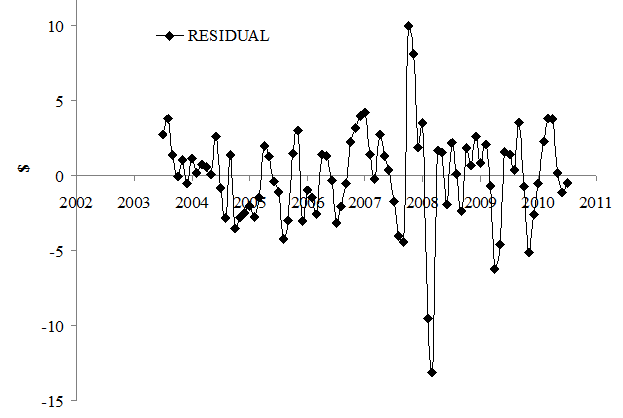


Figure 3. Residual error of the model. Mean residual error is 0 with standard deviation of $3.24. The largest errors were observed in 2007 and 2008.


References


Kitov, I. (2010). Deterministic mechanics of pricing. Saarbrucken, Germany, LAP Lambert Academic Publishing.

Prediction of Legg Mason share price

According to [1], the model for Legg Mason (LM) is defined by the index of food (F-CUUS0000SAF ) and that of appliances (APL-CUUR0000SEHK). The former CPI component leads the share price by 4 months and the latter one leads by 13 months. From our past experience, the larger is the lag the more unreliable is the model. However, both defining components provide the best fit model between August 2009 and June 2010. Both coefficients in the LM model are positive. This means that increasing food price forces the share price up. The fall in the index of appliances has been compensating *see Figure 1) both the increase in F and positive linear time trend in the share price, as defined by the slope of +33.024. So, the best-fit 2-C model for LM(t) is as follows:

LM(t) = 5.88F(t-4) + 8.29APL(t-13) + 33.024(t-2000) + 1425.45

The predicted curve in Figure 2 leads the observed price by 4 months with the residual error of $6.89 for the period between July 2003 and June 2010. In other words, the price of a LM share is completely defined by the behaviour of the two CPI components.

The model does predict the share price in the past and foresees no significant increase in the next quarter, in July through September 2010. Considering the overall fall in the S&P 500 in 2010, one should not expect any growth in stock prices at all.


Figure 1. Evolution of the price index of food (F) and appliances (APL).The latter has been falling since July 2009.

Figure 2. Observed and predicted LM share prices.

Figure 3. Residual error of the model. Mean residual error is 0 with standard deviation of $6.89. the largest errors were observed in 2005 and 2006.

References

Kitov, I. (2010). Deterministic mechanics of pricing. Saarbrucken, Germany, LAP Lambert Academic Publishing.

7/24/10

Apple share price. Revision, July 2010

Two months ago we presented a model and made a conservative prediction on AAPL share price. The model for AAPL(t), as introduced in [1], was as following

AAPL(t)= 19.03HFO(t-13) - 10.13HOS(t) + 73.86(t-1990) – 1862.5

where the index of housing furnishing and operations (HFO) leads AAPL(t) by 13 months. The index of housekeeping supplies (HOS) is synchronized with the price.

We also suggested that the price would be not growing at the same pace as in the beginning of 2010. Conditional on the decline in HOS, which was expected in April-July 2010, the share price might decline since May 2010. Figure 1 demonstrates that the actual price has been decreasing since May and this behaviour was well described by the model. One might expect that AAPL share will be falling together with S&P 500 into 2011.


Figure 1. Observed and predicted AAPL share prices.

References

Kitov, I. (2010). Deterministic mechanics of pricing. Saarbrucken, Germany, LAP Lambert Academic Publishing.

Mechanics of Inflation and Unemployment

Our monograph "Economics as Classical Mechanics" is under preparation.
We have compiled a draft version of Section 2.1 of Chapter 2 titled "Mechanics of Inflation and Unemployment". The interested reader may find Section 2.1 in pdf format here.

The contents:

2.1. Inflation, unemployment and labour force in the uSA
2.1.1. The (anti-) Phillips curve
2.1.2. Is labour force driving?
2.1.3. The model and data improvement
2.1.4. Forecasting inflation
2.1.5. Discussion

7/23/10

Mechanics of Gross Domestic Product

We are preparing a new monograph titled “Economics as Classical Mechanics”. This is the central part connecting two previously published monographs: “Mechanics of personal income distribution” and “Deterministic mechanics of pricing”. It is all about macroeconomics: GDP, inflation, unemployment, labor force participation rate, productivity, socialism capitalism transition. First chapater is called “Mecahnics of Gross Domestic Product”. We have prepared a draft version, which is now available here. The contents is as follows:
1.1. Real GDP per capita
1.1.1. The model
1.1.2. GDP per capita in the USA
1.1.3. Real GDP per capita Japan
1.1.4. More developed countries
1.2. Constant annual increment in real GDP per capita
1.3. Cointegration tests
1.4. Real GDP in the United States
1.5. Real GDP and S&P 500 stock market index.
We greatly appreciate any comments and criticism. The final version will likely be submitted by October 2010.


Chapter 2 (Mechanics of Inflation and Unemployment” ) is currently under initial editing and will be available for the interested readers by August 2010.

7/10/10

Deflation is approaching US

At last, deflation is approaching the US. A new post by Mark Thoma @ Economist's View:


How close to deflation are we?


Interstingly, five years ago we calculated that a deflationary period should start in 2012 and publsihed this forecast in 2006: Exact prediction of inflation in the USA.


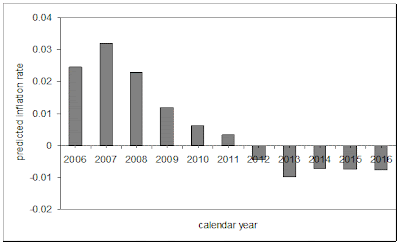
Below is Figure 9 from this paper. ALl predcitions between 2006 and 2009 were almost absolutely correct. So, inflation has not come yet, but will visit the US soon.

Figure 9. Predicted inflation rate for the period between 2006 and 2016.

Several months ago we presented the same graph with actual inflation readings in this blog:Sure - disinflation continues

7/6/10

First issue of Theoretical and Practical Research in Economic Field

The first issue of TPREF (the whole journal as a pdf file ) is available now. I am an author of one article and a co-editor.

Contents: 1

The Nexus Between Regional Growth and Technology Adoption:

A Case for Club-Convergence?

Stilianos Alexiadis

University of Piraeus …4

7

A Survey on Labor Markets Imperfections in Mexico Using a Stochastic Frontier

Juan M. Villa

Inter-American Development Bank … 97

2

Can Shift to a Funded Pension System Affect National Saving? The Case of Iceland

Mariangela Bonasia

University of Naples

Oreste Napolitano

University of Naples … 12

3

Global Supply Chains and the Great Trade Collapse: Guilty or Casualty?

Hubert Escaith

World Trade Organization … 27

4

Some Empirical Evidence

of the Euro Area Monetary Policy

Antonio Forte

University of Bari … 42

5

Modeling Share Prices of Banks and Bankrupts

Ivan O. Kitov

Institute for the Geospheres‟ Dynamics, Russian Academy of Sciences … 59

6

Infrastructures and Economic Performance: A Critical Comparison Across Four Approaches

Gianpiero Torrisi

Newcastle University … 86

Drang nach Osten — «натиск на Восток»

ИИ гугла написал « Drang nach Osten — «натиск на Восток») — это исторический термин, обозначающий германскую экспансию на славянские и восто...