2/1/23

Deflation is the next challenge for the USA

In December 2022, a deflationary period started in the USA. Formally, both the PPI (Final Demand) and CPI fell. In absolute values, the PPI fell from 140.721 in November to 139.544 in December, or by 1.18. When annualized, the PPI fell in December by 14.12 (12 months times 1.177) or by 10%.  Figure 1 shows the evolution of the monthly (annualized) PPI between Dec. 2011 and Dec. 2022. 

Figure 1. Annualized monthly dPPI/PPI from 2011 to 2022. In December 2022, the rate of fall was 10%. 

In absolute values, the CPI fell from 298.349 in November to 298.112 in December, or by 0.237. When annualized, the CPI fell in December by 2.84 (12 months times 0.237) or by 1.0%.  Figure 2 shows the evolution of the monthly (annualized) CPI between Dec. 2011 and Dec. 2022. 

Figure 2. Annualized monthly dCPI/CPI from 2011 to 2022. In December 2022, the rate of fall was 1.0%. 

The inflation period observed in the USA after the helicopter money was poured into the US economy in 2020 is quite different from all natural (related to labor force growth/shrinkage) inflation observed ever before. Figure 3 demonstrates that the money was transferred to people without any economic reason and the Personal Income in 2020Q2 was 104% of the nominal GDP with a long-term ratio of 87%. This money activated processes of spending and consumer price inflation in the earlier 2021, i.e. approximately 1.25 years after the money was added. This was not a normal way inflation works but rather a one-timer. The prices jumped repeating the money-added curve and the effect of the ballooned PI in Figure 2 is the jump in prices. When the effect of the helicopter money faded away with the PI/GDP ratio sunk below the long-term trend at the end of 2021 no other price increase is possible. With a 1.25-year delay between the money injection and the CPI reaction, consumer prices have to fall. And this process started in December 2022. 


Figure 3. The ratio of the quarterly personal income, PI, and nominal GDP (both as estimated by the BEA) and the evolution of CPI in the USA.


The observed CPI and PPI inflation rates (around 6%) are still high and it may cause some doubts at the start of a deflationary period. The high CPI/PPI estimates are the effect of the price jump many months ago. Figure 4 depicts the monthly CPI increment, dCPI. The largest monthly increment, 3.85, was observed in June 2022. It will affect the rate of inflation till June 2023 when this reading will not be counted in anymore. And the next increment in July 2022 was below 0. Then inflation will become negative on an annual basis. Before July 2023, the annual rate of inflation will gradually drop to 0, but the monthly inflation rate estimates will be all negative.

The deflation period will last longer than the current high inflation period. The reason is simple – the consumer and producer prices in December 2022 were at a much higher level than in January 2020: CPI by 15% and PPI (FD) - 17%. There is no money in the PI to match the new level of consumer and produced demand as expressed in new dollars, as Figure 3 shows. To print more (a few trillions of dollars) money is not as easy no as in 2020 as the debt ceiling is a big political issue before the 2024 elections. The total price fall will be larger than the growth by 15% -17% because price deflation is a self-promoting process.


Figure 4. Monthly CPI increment, dCPI. 

The deflation period will last longer than the current high inflation period. The reason is simple – the consumer and producer prices in December 2022 were at a much higher level than in January 2020: CPI by 15% and PPI (FD) - by 17%. There is no money in the PI to match the new level of consumer and produced demand as expressed in new dollars, as Figure 3 shows. To print more (a few trillions of dollars) money is not as easy no as in 2020 as the debt ceiling is a big political issue before the 2024 elections. The total price fall will be larger than the growth by 15% -17% because price deflation is a self-promoting process.

1/27/23

Chat GPT. Some thoughts

Started ChatGPT today. Formulated a question on the Gini ratio in the USA in a given age group. It does not have this information (the US Census Bureau publishes this information for more than 50 years at an annual rate). As expected with a very limited training set. 

Also watched (1) “Silicone Valley People Will Lose Their Jobs!” - Reaction To OpenAI Being A $29 Billion Company - YouTube with Neil deGrasse Tyson. 

Some thoughts

ChatGPT can extremely well mimic (machine learning) something existent but cannot, for example, create Tupac's songs, which he would write if lived longer. A good example from the world of art is Malevich, who strived for new ideas and found the black rectangular (suprematism) by chance. He was not popular enough with this idea, however, and only the high post in the new Soviet government gave him needed PR tools to promote the black square and suprematism (dead now).

The question is can AI create a new art direction that does not exist right now which also fits human feelings and rational thinking in a way as Monet, Picasso, and Malevich inventions? It could be easily tested by providing all needed data known before some know invention and forcing AI to generate future inventions. Unknown would be even more interesting than known.

Another issue - the human judgment. Music and arts are evaluated and accepted/ignored not on the basis of logic but some other considerations. Saying that I suddenly understood that this that is easily manipulated. Likely, some hidden ChatGPT already drives our taste and disgust. Moreover, it can be a human idea behind this hidden AI which rules the world already. I guess that the liberal fever in the USA fits this pattern ideally. This is a dramatic move from the rooting interest of human beings to emotional hysterics.

1/23/23

Malevich's black square and the nothingness as the next step of art

The black square of Malevich absorbed and better than other arts expressed the spirit of madness before WWI. This is a symbol of the gradual transformation of a person into nothingness through degradation into an increasingly wild and aggressive creature, as shown by the European Nazis/fascists and the Japanese during WWII. The degradation all started with Monet, who presented people as soulless motley spots, while classical art was looking for expression of the (yes, Christian) spirituality of a person's face and hands (for good deeds). Picasso split a human being into a set of pieces, almost not connected with either the body or the soul. Malevich brought the idea of the absence of humans to the ultimate principle - there is neither body nor soul. Full dehumanization. But there are forms instead. After World War III, only nothingness will remain, under which the entire history of mankind will be hidden, including the black Suprematist rectangle. The formless will absorb all forms and this will be the ultimate victory and end of art, which is likely more important than life. Malevich was a member of a futurist club and his companion poet Kruchyonykh wrote a  piece where the last quatrain was empty, i.e. nothingness was foreseen by futurists. 

1/22/23

Черный квадрат Малевича

Черный квадрат впитал и лучше других искусств выразил дух сумасшествия перед первой мировой войной. Это символ постепенного превращения человека в ничто через деградацию во все более дикое и агрессивное существо, как показали европейские нацисты/фашисты и японцы во время второй мировой. Все началось с Моне, который представил людей в виде неодушевленных пестрых пятен, в то время как классическое искусство искало внешнего выражения (да, христианской) одухотворенности человека. Пикассо превратил человека их человекоподобного пятна в набор кусочков, почти не связанных ни с телом ни с душой. Малевич довел идею отсутствия человека главный принцип - нет ни тела ни души. Но есть формы. После третьей мировой останется только черная дырка, под которой будет скрыта вся прошлая история человечества, включая черный супрематический прямоугольник. Бесформенное поглотит все формы и это будет венец и конец искусства, которое выше жизни.  

12/13/22

As we predicted, CPI inflation much below the forecasted by WSJ. FOMC to reconsider the tomorrow's decision

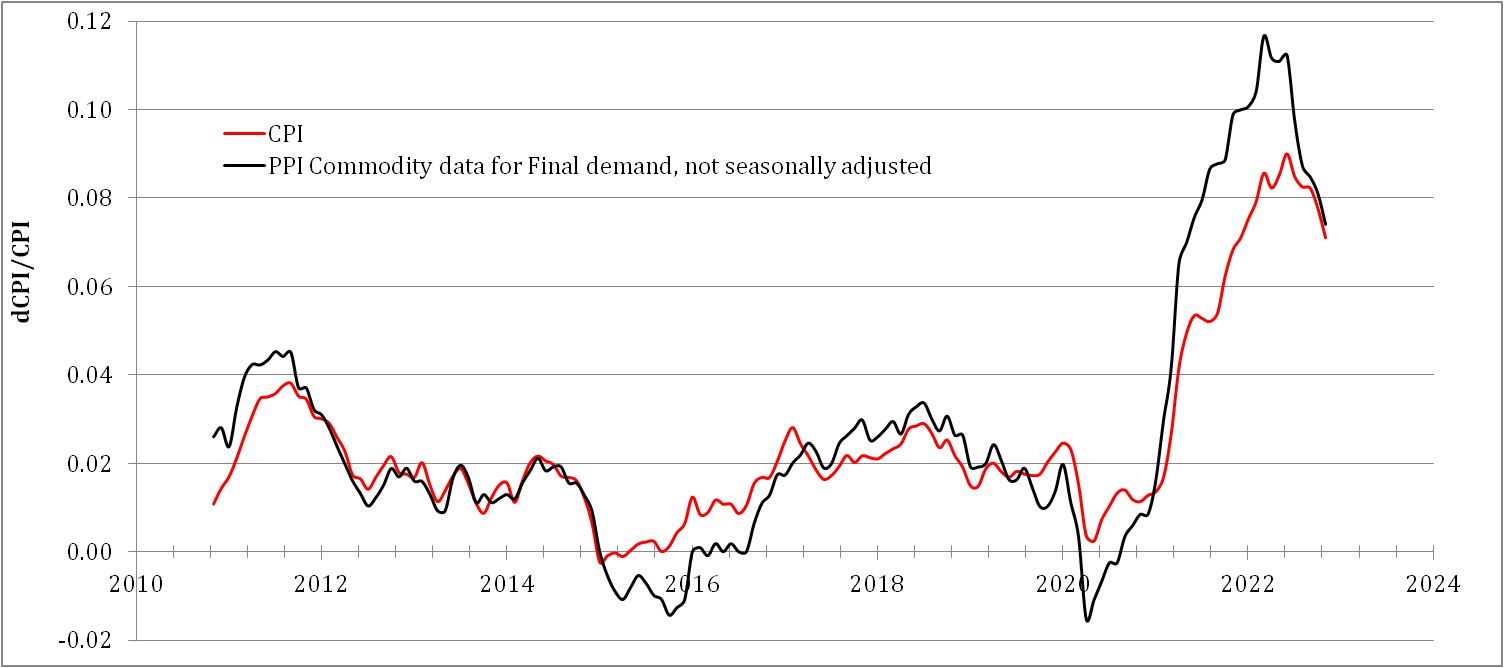
The current fall in the CPI inflation is down to 7.1% per year and +0.1% in November relative to October 2022. This is much lower than the expected +0.3%, which would mean 7.3% during the past 12 months. I was not too optimistic about waiting for the figures below 7.0%. The 0.1% difference is within the measurement uncertainty and may change in the following revisions. Figure 1 presents the comparison of the PPI (Final Demand) and CPI inflation rates.

The faster-than-expected fall in the CPI inflation will change the FOMC consideration tomorrow. 

Figure 1


12/9/22

New PPI data indicate the possibility for the CPI inflation to drop below 7% per year in November

The BLS released new PPI data showing the drop in the inflation rate of PPI for final demand from 8.1% in October to 7.4% in November. The (seasonally adjusted) PPI increased from 140.637 in October to 140.795 in November. Figure 1 compares the PPI inflation with that of the CPI. One can see that the two curves started to diverge in 2020. The PPI curve demonstrates a fast fall since 2022Q1 when it reached its peak of 11.6%. The CPI curve started to fall in July and currently chasing the PPI curve as it falls below the zero line. The BLS will release the CPI data on Dec 13. The expected value of the CPI inflation for the 12 months that ended in November is below 7% with the October level of 7.8%. 

Figure 1. Comparison of the CPI and PPI (FD) inflation rates after 2010


Now on arXiv.org "Effects of stochastic and natural seismic noise on the performance of waveform cross-correlation used to recover low-magnitude seismicity prior to the July 29, 2025, Kamchatka earthquake"

arXiv.org link :  [2607.16226] Effects of stochastic and natural seismic noise on the performance of waveform cross-correlation used to reco...