5/13/16

On the rate of economic growth in BRIC

This post extends our previous analysis of the long term GDP growth in developed countries with BRIC.

Table 1 lists average annual increment of GDP per capita (1990 USD) in developed countries. The best countries demonstrated increments above $350 per year. Many European countries are between $300 and $350 per year. It is possible to conclude that intertial economic growth is somewhere between $320 and $390 per year (in PPP 1990 US dollars). Some European countries demonstrate poor performance, e.g. Italy, France, Portugal, Greece.
The long term annual increment for a given country completely defines the rate of economic growth. According to their GDP per capita levels, all developed countries are characterized by the rate of inertial growth within the range between 1.5% per year and 2.5% per year. One should not expect higher rates, with a low probability of short term fluctuations.
Let’s apply the notation of inertial economic growth to BRIC countries and assess their performance in terms of their potential rate of inertial growth. Table 2 lists mean annual increment in GDP per capita in four BRIC countries, which are rather low:  from $64 in India to $114 in China over the same period between 1960 and 2015. This is three to four times smaller than that in developed countires. Hence, BRIC countries demonstrate poor performance over longer period.
However, China figures look much better at a shorter interval of the past 20 years. The annul increment is $242, i.e. approximately 70% of that in Austria and at the level of France. Since the level of GDP per capita in China is extremely small by European standards, the rate of growth is much  higher – between 3% and 10% per year. (Here we use data for China, not China-old, from the Total Economy Database.)  
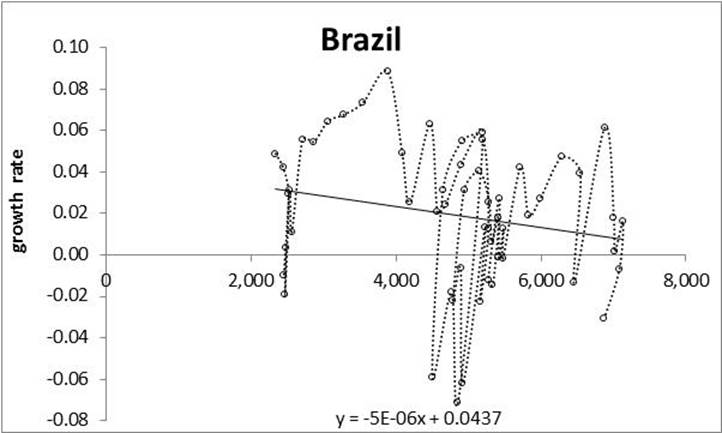
The current rate of 3% to 4% per year is much smaller than  one could expect when China would grow along intertial trajectory of European countries. Figures 1 thru 4 depict various versions of growth trajectories for BRIC countries.

Table 1. Mean annual increment of GDP per capita

Mean, 1960-2015
Austria
340
Belgium
326
Denmark
282
Finland
320
France
274
Germany
281
Greece
159
Ireland
357
Italy
212
Netherlands
304
Norway
363
Portugal
191
Spain
240
Sweden
313
Switzerland
262
United Kingdom
286
Canada
323
United States
387
Australia
338
New Zealand
203
Japan
345

Table 2. Annual GDP per capita increment in BRIC countries

1960-2015
1995-2015
China
114
242
India
64
134
Brazil
83
82
Russia
105
201


Fig. 1. The evolution of real GDP per capita in China from 1960 to 2015. Three graphs demonstrate annual increment as a function of GDP per capita, annual increment as a function of time, and the growth rate (1/year) as a function of GDP per capita.


Fig. 2. The evolution of real GDP per capita in India from 1960 to 2015. Three graphs demonstrate annual increment as a function of GDP per capita, annual increment as a function of time, and the growth rate (1/year) as a function of GDP per capita.


Fig. 3. The evolution of real GDP per capita in Brazil from 1960 to 2015. Three graphs demonstrate annual increment as a function of GDP per capita, annual increment as a function of time, and the growth rate (1/year) as a function of GDP per capita.


Fig. 4. The evolution of real GDP per capita in Russia from 1960 to 2015. Three graphs demonstrate annual increment as a function of GDP per capita, annual increment as a function of time, and the growth rate (1/year) as a function of GDP per capita.

Illustration of falling economic growth in developed countries

In this post, we continue analysis of GDP per capita in developed countries and BRIC. It was shown in two previous posts that the evolution of real GDP per capita is rather linear (not exponential) since 1960 and in many cases the growth rate is much lower than its linear potential (so called inertial growth). Extended analsyis was presented in our papers and we would like here just to stress the fact that many developed countiries demonstarte poor performance.


Fig. 1. Austria: annual increment of real GDP per capita (upper panel) and the corresponding rate of growth (lower). On average, the annual increment between 1960 and 2015 is $340.  The growth rate has clear negative trend from 1960 to 2015. The current growth rate fluctuates around 1.5% per year.


Fig. 2. Same as in Fig. 1 for Belgium. On average, the annual increment between 1960 and 2015 is $326


Fig. 2. Same as in Fig. 1 for Denmark. On average, the annual increment between 1960 and 2015 is $282.


Fig. 4. Same as in Fig. 1 for Ireland. On average, the annual increment between 1960 and 2015 is $357. There was a period of extremely high growth rate, which ended with a tremendous fall completely compensating the years of growth.


Fig. 5. Same as in Fig. 1 for Netherlands. On average, the annual increment between 1960 and 2015 is $304
 

Fig. 6. Same as in Fig. 1 for Norway. On average, the annual increment between 1960 and 2015 is $363


Fig. 7. Same as in Fig. 1 for Portugal. On average, the annual increment between 1960 and 2015 is $191


Fig. 8. Same as in Fig. 1 for Sweden. On average, the annual increment between 1960 and 2015 is $313


Fig. 9. Same as in Fig. 1 for Canada. On average, the annual increment between 1960 and 2015 is $323


Fig. 10. Same as in Fig. 1 for Australia. On average, the annual increment between 1960 and 2015 is $338


Fig. 11. Same as in Fig. 1 for New Zealand. On average, the annual increment between 1960 and 2015 is $203


Fig. 12. Same as in Fig. 1 for Japan. On average, the annual increment between 1960 and 2015 is $345

5/10/16

Decaying economic growth in EU as an economic argument for Brexit

In our previous post, we demonstrated the fall in the rate of economic growth observed in the USA since 1960. Overall, there exists a strong negative trend expressing the fundamental property of economic growth – constant annual increment. Explained in simple words, an economy goes up with steps on constant height, like stairs. This was an example of benign growth, however: the rate of growth follows theoretical predictions. For Europe, however, everything is much worse. Some of the biggest economies demonstrate an accelerated decay.

In the past, we published a number of papers [1, 2, 3] and a book on the evolution of real GDP per capita and explained what does mean inertial economic growth, i.e. the growth with constant steps in real GDP per capita. We have proven that developed economies grow with a constant step, not at a constant rate. Theoretically, the rate of economic growth has to be inversely proportional to the attained level of GDP per capita. Here, we use the estimates of real GDP per capita as listed in the Total Economy Database managed by the Conference Board.

Two figures below update our previous results obtained for Germany, France, Italy, Switzerland, and the UK. Four countries (France, Italy, Spain, and Switzerland) demonstrate extremely poor performance during the past decades. Germany is on par with theoretical predictions and the UK is slightly over the predicted growth rate but still on the negative trends since 1960. The EU is under severe stress in the years to come since the future of economic growth is likely dark. Germany follows its cruise speed and unlikely to spill economic growth over the other biggest economies.

It might be good time for the UK to think about the traction forces associated with the clear features of economic stagnation in EU.


Fig. 1. Evolution of annual increment of GDP per capita, i.e. the difference of the current GDP per capita and that one year ago.


Fig. 2. The rate of growth of the real GDP per capita.

On the decaying rate of economic growth in the USA


We have published a few papers [1, 2, 3] and a book on the evolution of real GDP per capita. The message is very simple – economies grow with a constant step, not a constant rate. Therefore, the rate of economic growth is inversely proportional to the attained level of GDP per capita. Three figures below just update our previous results obtained for the USA using new estimates for the past three years. How dare economists confuse people and authorities with fairy tales that the rate of economic growth will return to that observed in the 1960s. The average rate of 3% per year will never happen again, short term excursions are possible, although. In the long run, the rate of growth will fall from the current 1.6% to 1% per year in 2035.


Fig. 1. Evolution of annual increment of GDP per capita, i.e. the difference of the current GDP per capita and that one year ago.


Fig. 2. Annual increment of the GDP per capita as a function of real GDP per capita.


Fig. 3. The rate of growth of the real GDP per capita. Currently, it is about 1.6% per year and will be above 1% another 20 years.


3/13/16

Modeling economic success of Poland and failure in Russia and Ukraine. The 2015 model revision

In 2005, I developed and presented at the Fourth Annual EEFS Conference (Faculty of Economics, University of Coimbra, Portugal 19-22 May 2005) a paper “Modelling the transition from a socialist to capitalist economic system” (Slide Share). An extended and updated version was published in the JAES in 2009.  
My model predicts the measured evolution of real GDP per capita and is based on two fundamental physical laws - the decay of socialist system is similar to radioactive decay and the growth of capitalist system is similar to the process of exponential saturation. The predictive power of the model was extremely high even for the realm of physics and accurately described the transition from socialist to capitalist economic system from 1989 (East Europe) and 1991 (Former Soviet Union) to 2003-2007. Ukraine was an excellent example of the model success. Figure 1 shows the observed and predicted curves with the extension to data available in 2016 (we use the Total Economy database from the Conference Board as data source). Two curves are very close between 1991 and 2006.  In 2007, a slight deviation from the predicted curve starts, which then developed in a catastrophic fall in GDP to the level of 0.802 relative to 1991. Essentially, the level of GDP per capita in Ukraine now resides in the earlier 1970s, i.e. half a century in the past.  The predicted curve implies that the rate of growth had to be 3.65% per year (as observed from 1995) and thus had to be in 2015 at 1.84 (relative to 1991).  Missed opportunity.
Russia (Figure 2) presents an intermediate case with a healthy evolution before 2008, recession in 2009-2010, quick recovery and then stagnation at the level of 1.3 relative to 1991 instead of permanent growth at a rate of 3.5% per year. It has to be at 1.8 in 2015. 
Poland is likely the best performer between the former socialist countries. Poland fully uses its growth potential –  real GDP per capita grows at a rate of 3% per year since 1991. Our model cannot predict total (Ukraine) or partial (Russia) economic failures, which are likely in tight connection with national and international political turmoil, but our model accurately predicts the evolution of GDP per capita when growth potential is used in full. Poland has been chasing developed countries and it is the best example for Ukraine and Russia (and for other former socialist countries), which are hardly to be able to return to the full growth potential any time soon. The gap between them and developed countries rises at a threatening rate. 


Figure 1. Comparison of the observed and predicted evolution of real GDP per capita in Ukraine.


Figure 2. Comparison of the observed and predicted evolution of real GDP per capita in Russia.


 Figure 3. Comparison of the observed and predicted evolution of real GDP per capita in Poland.  The transition started in 1989.


3/5/16

EU, Syria, migrants and Russia

There are some speculations on the effect of  the Russian campaign in Syria on migration in EU.
The EU statistics gives actual numbers to illustrate this effect  - Russia has helped to reduce the monthly rate  of first time asylum applicants.

Trump, trap, Iran

Trump announced an ultimate goal of the agreement with Iran - no bomb. This is a trap for Trump. Imagine, Iran signs such an agreement. Trum...